
Air quality monitoring has long followed a familiar pattern: expensive instruments, sparse networks, and data locked behind institutional barriers. That approach served its purpose in the past – but it no longer meets the demands of modern society. Today, new technologies and economic models are opening the door to something fundamentally different: Decentralized Physical Infrastructure Networks (DePINs). Within the LuMUB project (Luftqualitäts-Monitoring von Ultrafeinstaub in einer Blockchain, German acronym for Air Quality Monitoring of Ultrafine Particles (UFPs) within a Blockchain) and the nanoDUST AirPN10, we have assessed the economic feasibility of this new approach.
What is Decentralized Physical Infrastructure Network?
Decentralized Physical Infrastructure Networks, or short DePINs, at its core describe a system where physical assets—such as sensors, communication devices, or energy systems—are not owned and operated by a single entity, but are instead distributed across many participants. These assets are coordinated and managed via blockchain-based systems, which ensure transparent ownership, secure data handling, and automated transactions between stakeholders.
Participants can be:
- Private investors
- Companies
- Institutions
- Even individuals
Ownership and operation are coordinated through digital platforms, often supported by tokenization. Instead of one organization carrying all the cost and risk, infrastructure is collectively financed, deployed, and maintained.
In simple terms: DePIN turns infrastructure from a centralized cost burden into a shared economic opportunity.
Why DePIN Makes Sense for Air Quality Monitoring
Traditional air monitoring networks are limited by one thing above all: cost. High-quality instruments are expensive, which leads to low spatial coverage. They are maintainted by highly-educated personnel, causing high operational expenses. The result is a coarse picture of air pollution—useful for regulation, but insufficient for understanding real exposure.
DePIN changes that equation fundamentally.
Key advantages:
- Dense measurement networks
Instead of a handful of stations, DePIN enables scaling to hundreds or even thousands of nodes. This may provide high-resolution spatial data—something that has been missing for decades. - Investment-driven expansion
Infrastructure grows where there is demand. Investors fund new nodes because they expect returns from data usage—not because a public budget allows it. - Shared ownership through tokenization
A single instrument no longer needs a single owner. Investment can be split, lowering entry barriers and spreading risk. - Engagement beyond institutions
Municipalities, companies, and even citizens can participate. This creates a network that reflects real-world needs rather than administrative boundaries. - Sustainable scaling
Instead of large upfront investments, networks grow organically—node by node—based on economic viability. First stations will start where specific issues may be suspected, and the more dense the network becomes, the more value the data provides.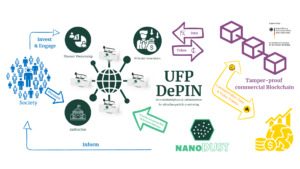
Concept for a UFP DePIN
Why Ultrafine Particle Monitoring is a Good Starting Point
Most existing monitoring networks focus established quantities, like weather data, PM2.5 particulate matter or similar low cost sensing technologies. That made sense historically because these were the measurable quantities of interest, or regulated pollutants. Yet, the data they generate in DePINs always competes against existing data available, sometimes even free-of-charge.
In comparison, ultrafine particle pollution is a real blind spot on the map today!
The situation is clear:
- Almost no large-scale data exists
- Health relevance is increasingly recognized
- Measurement is still expensive and technically demanding
This combination creates a gap—and gaps are where new infrastructure models prove their value. UFP monitoring is not suited for cheap, low-cost sensors. It requires robust, scalable quality instrumentation. That is exactly why DePIN is the right approach: It distributes the financial burden while unlocking access to critical data.
The Role of the nanoDUST AirPN10 in a DePIN Network
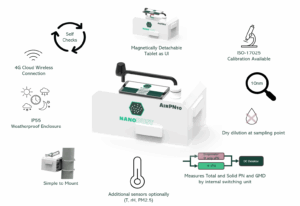 The nanoDUST AirPN10 is designed precisely for this kind of deployment. It is an established ultrafine particle monitoring technology based on diffusion charging technology that has already been scaled to ten thousand of units in the automotive emission field. Within a DePIN structure, it becomes:
- A data-generating asset, not just a measurement device
- A node in a distributed network, contributing to a larger dataset
- A revenue-generating unit, funded by investors and paid through data usage
A possible Integration looks like this:
- Investors finance AirPN10 units
- Devices are deployed at relevant locations (e.g., airports, urban hotspots, industrial areas)
- Data is continuously collected and transmitted
- Customers (e.g., infrastructure operators, researchers, authorities) pay for access to the data
- Revenue flows back to investors
The instrument is no longer the product. The data is.
From Owning Devices to Buying Data
One of the biggest inefficiencies in traditional monitoring is that every stakeholder has to individually take care about the hardware and things like:
- Procurement
- Maintenance
- Calibration
- Operation
This is not their core business. Surveillance of data and taking the right regulatory actions is. With DePIN, that burden disappears.
Stakeholders benefit by:
- Accessing ready-to-use, high-quality data
- Avoiding capital expenditure on instruments
- Focusing on decision-making instead of measurement logistics
Here are some examples how this can work out:
- An airport does not need to operate a measurement network—it needs reliable data on emissions and exposure.
- A city does not need devices—it needs insight for policy.
- A research group does not need infrastructure—it needs datasets.
DePIN delivers exactly that: A Clear Value Proposition for Investors.
This model only works if it makes economic sense. Fortunately, from our assessment within the LuMUB project we can say: It does!
Consider this: In a country like Germany, there is 16 provinces operating, maintaining, surveilling high-end equipment stations. Yet, the data they provide are long-term trends, but not real local exposure. For the new EU Air Quality Directive, they will all roughly set up one measurement station, with the need of reference equipment worth 100k€ plus an academic employee to operate the devices, yearly maintenance costs, initial training, purchasing efforts, etc. And this is for 16 measurement stations only! Within a DePIN of reliable mid-cost sensors, this budget would allow to set up a network of about 300 stations. With lower cost of operation in the future! Official monitoring stations will still play an important role for data integrity, reference points, long-term high-accuracy trends and reliability. But the large amount of data must be generated by different approaches!
Investors Gain
Not only society profits but also investors. They get:
- Access to a new asset class (physical infrastructure tied to data markets)
- Revenue streams from data usage
- Scalable investment opportunities
- Participation in early-stage, high-impact networks
Unlike traditional infrastructure, returns are not tied to ownership alone, but to data demand. As demand grows, so does the value of the network.
Benefits for Society
There is a tendency to overcomplicate these discussions. The societal benefit is straightforward: More data leads to better decisions, and better decisions lead to better health outcomes. A dense, reliable UFP monitoring network enables:
- Identification of pollution hotspots
- Improved urban planning
- More effective regulation
- Increased transparency
In short: What was once measured roughly can now be understood precisely.
The LuMUB Project – A Start into a New Era of Ultrafine Particle Monitoring?
The LuMUB project provided the framework to turn this concept into reality. With support from funding programs and strong partners — including TH Aschaffenburg (THAB) — the project brought together:
- Economic expertise
- Technology know.how
- Market demands
The questions raised at the start of the project: Can this work out? Our answer: Yes! LuMUB is not a theoretical exercise. It is the starting point for a new kind of monitoring network—one that combines proven measurement technology with modern economic structures. It will not replace existing public monitoring stations, it complements them!
A Call for First Movers
Every new system needs those willing to move first. We are looking for partners who understand that:
- Data is more valuable than hardware
- Flexibility beats ownership
- Early participation creates long-term advantage
Ideal Partners include:
- Airports
- Infrastructure operators
- Industrial sites
- Municipalities
- Research institutions
- any institution interested in health-relevant ultrafine particle data
If you are willing to pay for data instead of devices, we can deploy the network for you.
Conclusion
Air quality monitoring has been done the same way for decades: centralized, expensive, and limited. That time is over. DePIN offers a model that is:
- Economically viable
- Technically robust
- Scalable by design
With the nanoDUST AirPN10 and the LuMUB project, the pieces are in place.
Now it comes down to execution—and to those who recognize the opportunity early. If you want better data without the burden of infrastructure, this is the moment to act.
Acknowledgements
We are grateful to the German Federal Ministry of Economic Affairs and Climate Action for the funding within the framework of the “Innovation Program for Business Models and pioneering solutions” and the TH Aschaffenburg for the scientific consultation and advisory on the project.


Leave A Comment